| Table of Contents |
|---|
| Introduction |
| History |
| Traditions |
| Symbols |
| Rituals |
| Frequently Asked Questions |
| Conclusion |
Introduction
Day of the Dead, known as “Dia de los Muertos” in Spanish, is a vibrant cultural celebration that originated in Mexico and is now observed in various parts of the world. This multi-day holiday, which takes place from October 31st to November 2nd, is a unique combination of pre-Columbian rituals and Catholic traditions. It is a time when families and communities come together to honor and remember their loved ones who have passed away.
History
The roots of Day of the Dead can be traced back to the ancient indigenous civilizations of Mexico, such as the Aztecs, Mayans, and Toltecs. These civilizations believed that death was not the end, but rather a continuation of life in another form. They viewed death as a natural part of the human journey and saw the dead as cherished ancestors who continued to play a role in the lives of the living.
When the Spanish arrived in Mexico in the 16th century, they brought with them Catholicism. The Catholic Church attempted to syncretize the indigenous beliefs with their own traditions, resulting in the fusion of Day of the Dead with All Saints’ Day and All Souls’ Day, which are observed in the Catholic calendar on November 1st and 2nd respectively.
Traditions
Day of the Dead is a time of joyful celebration and remembrance. Families visit cemeteries to clean and decorate the graves of their loved ones. Altars, known as “ofrendas,” are created in homes, schools, and public spaces. These altars are adorned with photographs, favorite foods, drinks, and belongings of the deceased, as well as marigold flowers, candles, and sugar skulls.
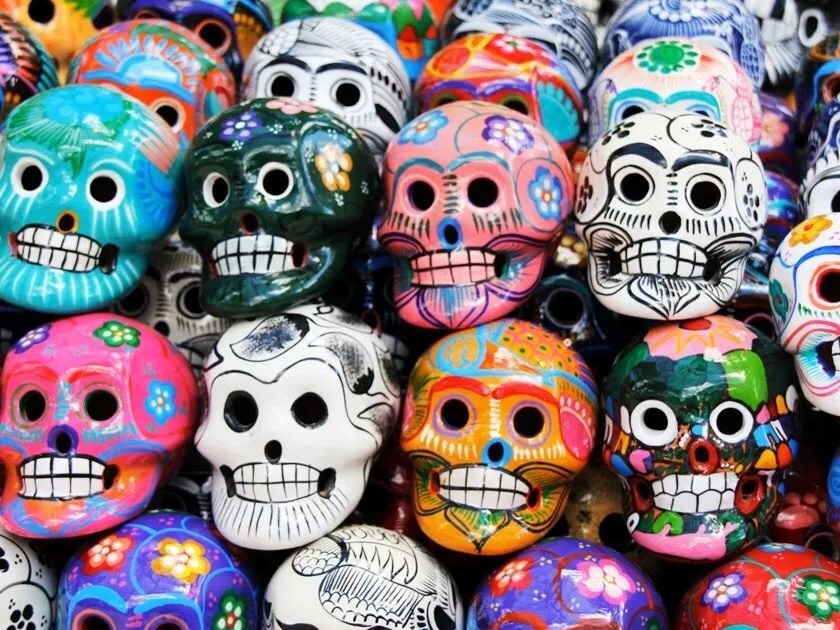
Another important tradition is the creation of “calacas” and “calaveras,” which are colorful and whimsical skeleton figurines and images. These are often portrayed engaged in various activities, reflecting the joy and humor associated with Day of the Dead. People also dress up in elaborate costumes, paint their faces as skulls, and participate in parades and processions.
Symbols
Several symbols are associated with Day of the Dead, each carrying its own significance. The marigold flower, or “cempasuchil,” is believed to attract the souls of the dead with its vibrant color and scent. Skulls, or “calaveras,” represent death and the departed souls, while sugar skulls, or “calaveritas de azúcar,” are intricately decorated edible offerings. Monarch butterflies are believed to carry the souls of the departed, and incense, known as “copal,” is used to purify and guide the spirits.
Rituals
Day of the Dead is filled with various rituals and practices. Families gather at the cemeteries to clean and decorate the graves, often staying overnight to keep the company of their loved ones. They share stories, sing songs, and recite prayers while enjoying food and drinks. Some families also hold private ceremonies at home, where they create altars and offer prayers for the souls of their departed loved ones.
At midnight on November 2nd, known as “la Alborada,” candles are lit and fireworks are set off to welcome the souls back to the world of the living. It is believed that during this time, the spirits of the dead visit their families and enjoy the offerings placed on the altars. The celebration culminates in a grand parade, filled with music, dancing, and elaborate costumes.
Frequently Asked Questions
-
What is the significance of Day of the Dead?
Day of the Dead is a way for people to remember and honor their loved ones who have passed away. It allows for the celebration of life and the belief in the continuity of existence beyond death.
-
Is Day of the Dead a solemn or joyful occasion?
Day of the Dead is a joyful occasion filled with love, laughter, and celebration. It is a time to cherish the memories of the departed and to reflect on the beauty of life.
-
Can people of other cultures participate in Day of the Dead?
Day of the Dead is a celebration that welcomes everyone, regardless of their cultural background. It is a time for people to come together, learn about different traditions, and celebrate the universal theme of life and death.
Conclusion
Day of the Dead is a vibrant and culturally rich celebration that allows individuals and communities to remember and honor their loved ones who have passed away. Through its traditions, symbols, and rituals, this unique Mexican holiday celebrates the continuity of life and the belief in the presence of the departed in the lives of the living. Day of the Dead serves as a reminder that death is not an end, but rather a celebration of the human journey.
By preserving and passing on the traditions of Day of the Dead, we pay tribute to our ancestors and keep their memories alive for future generations. So let us embrace this colorful and meaningful celebration, and join together in celebrating life, love, and remembrance.


daxktilogibigibi.isximT4xCuzF
daktilogibigibi.n4aXNFrFnhwV
vurcazkircazpatliycaz.WuB48mpzbujh